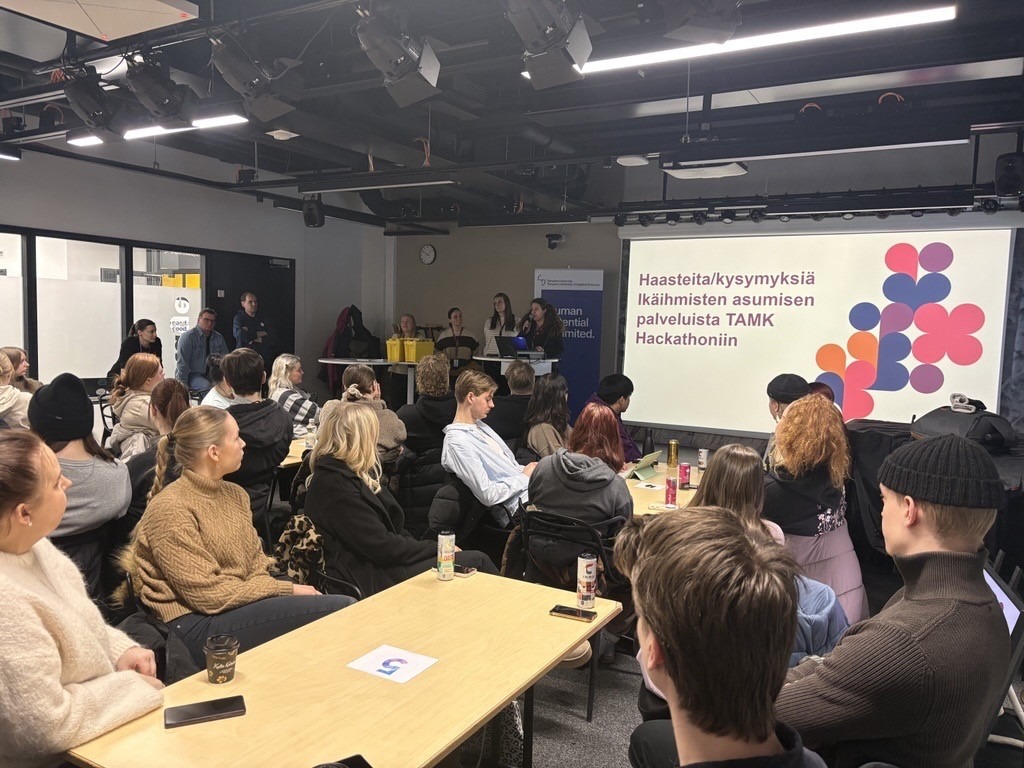
This year’s hackathon was built on the event first organized in 2025, created by senior lecturer in social services Sanna Keskikuru, senior lecturer in nursing Marjo Tienari, and mechanical engineering senior lecturers Mikko Korpela and Ville Jouppila. The concept is rooted in bringing students together, helping them practice working in multidisciplinary teams, and supporting TAMK’s strategic goals: positioning itself as a multidisciplinary university of applied sciences and responding to the evolving competence needs of working life.
A key new feature in the 2026 hackathon was that the challenges came directly from professionals in the field. Students received eight authentic challenge themes from representatives of elderly care services at Pirha. These representatives also introduced the operational environment behind the challenges and outlined the types of solutions they were hoping for—ideas that would combine the expertise of social and health care with technical skills and understanding. They further supported the teams by sparring ideas on the opening day, attended the pitch presentations, and selected the winning teams.
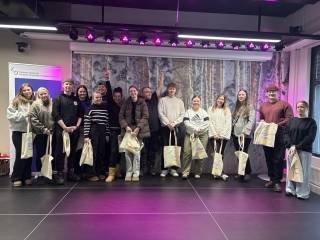
The hackathon was integrated into the students’ degree studies. For social services and nursing students, the event formed part of the User-Centered Wellbeing Technology course, while for machine automation students it was linked to the Machine Automation Laboratory course. The learning objectives were based on the key cross-sectoral competence needs identified by the Finnish National Agency for Education’s Foresight Forum (2019). These included customer-oriented service development skills, interaction, communication and collaboration skills, as well as the ability to manage remote and virtual services.
Hackathon teams consisted of groups of six to eight students, with each team including representatives from all three disciplines. At the start of the hackathon, teams worked on building their group identity and agreeing on shared ground rules. They then selected a challenge to solve. Students were allocated three full working days over a ten-day period to develop a solution, produce documentation, and prepare their pitch. The fourth session was dedicated to pitching: each team had five minutes to convince the audience of the value of their innovation. The event concluded with voting and awarding the best student-selected pitches, as well as recognizing the top teams chosen by Pirha’s representatives.
So, what were the innovations? The students produced a wide range of impressive ideas and solutions. Some were based on existing technical solutions combined in new ways, while others represented entirely new technological concept ideas that may soon be ready for real-world use. The innovations included, among others, operational management systems, new types of safety-enhancing sensor technology, and AI-based operational control. The pitches featured videos, 3D prints and even elements of drama.
Student feedback highlighted the hackathon as a highly successful and rewarding experience. Team spirit and collaboration worked exceptionally well, and the multidisciplinary setup was considered both educational and eye-opening. Many students felt they gained new perspectives and a deeper understanding of how different fields work. Clear organization, a well‑structured schedule, and strong support from teachers were frequently praised. Most students said they would recommend the hackathon to their peers.
The SoteKone Hackathon is an excellent example of the RDI work carried out at TAMK. During the event, students were invited to participate a survey exploring their experiences with TAMK’s RDI activities. The survey is part of the international PATHS project, funded by Erasmus+. The purpose of the project is to develop a roadmap and a toolkit that enable the more systematic integration of students into applied research, development and innovation projects. The project is coordinated by Technische Hochschule Würzburg-Schweinfurt in Germany. Other partners are Kauno Kolegija in Lithuania, Tampere University of Applied Sciences in Finland, and The Hague University of Applied Sciences in the Netherlands as partners.