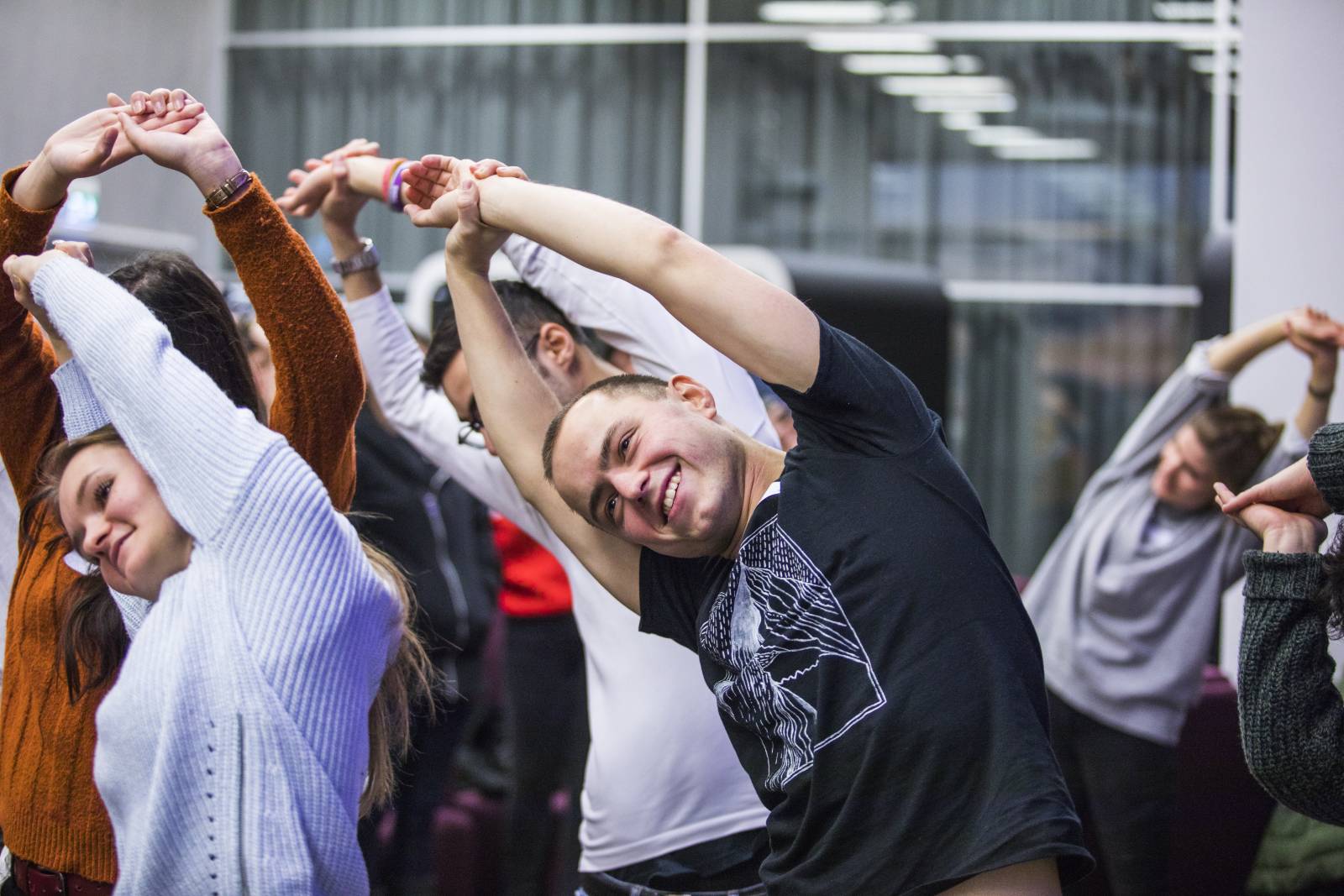
Learning is influenced by many dynamically interacting factors, one of which is perceived alertness. Alertness refers to how a person perceives the state of their body and mind at any given moment. It can also be thought of as a measure of activity or energy levels. Students may be hyper-aroused, hypo-aroused, or optimally aroused. For learning, the best state of alertness lies somewhere between hyper- and hypo-arousal. In this state, it’s easiest to focus and interact with others. Learning becomes smooth and meaningful.
Gas or brake? – Regulating alertness with break-time exercise:
- Assess your current state of alertness:
- Hyper-arousal: Sense of urgency, hyper-alertness, irritability, excitement, happiness.
- Optimal alertness: Ability to concentrate, a sense of balance, relaxation, feeling of safety, ease in regulating emotions, smooth interaction, and learning.
- Hypo-arousal: Sadness, dullness, fatigue, slowness, calmness, relaxation.
Choose the type of break-time exercise based on whether you need to “press the gas” (increase alertness) or “press the brake” (decrease alertness). If you feel your alertness is good for learning/work, aim to maintain that level.
- To increase alertness (gas):
- Stand up.
- Observe your surroundings using different senses.
- Move with rhythmic and repetitive motions like stomping feet or jumping.
- Perform strong strokes or pats on the body’s limbs.
- Strengthen and lengthen your inhalation, either on its own or combined with movement.
- To reduce alertness (brake):
- Observe your environment and notice the space around you.
- Use stroking, massaging, or hugging.
- Apply strength, such as squeezing or pushing movements.
- Gently lengthen your exhalation, either on its own or combined with movement (activates the vagus nerve, which promotes relaxation).
Reassess your alertness after the exercise. These exercises are designed to be suitable both for individual practice and group settings in classrooms. A teacher can observe the general state of alertness in the class and select the necessary exercise accordingly or allow students to assess their own alertness and independently aim to regulate it. Discussions can also be held on how these practices will benefit well-being and the ability to learn.
Learning is influenced by many dynamically interacting factors, one of which is perceived alertness. Alertness refers to how a person experiences the state of their body and mind at any given moment. It can also be considered a measure of activity or energy levels. Students may be hyper-aroused, hypo-aroused or optimally aroused. For learning, the ideal state lies somewhere between hyper- and hypo-arousal. In this state, it is easiest to concentrate and interact with others. Learning becomes smooth and meaningful.
Students can assess their own alertness and choose either an activating or calming exercise depending on the situation.