
Three key insights emerged that align directly with Tampere University’s ongoing research on AI, urban development, and data-driven decision-making.
1. AI Progresses in Phases — Human Role Remains Central
The conference reiterated that AI adoption in cities follows a gradual trajectory. Initial deployments target operational productivity gains of 30–35%. The next phase introduces AI agents integrated into team workflows to tackle complex challenges. Ultimately, humans act as architects of AI-augmented systems: setting objectives while AI supports execution.
Microsoft’s AI Frontier Organization model captured this progression: AI becomes part of an organizational operating culture, not a standalone tool. Employees are empowered to use AI responsibly and effectively, supported by structures that enable continuous learning.
Examples included Montreal, where 85% of citizen service interactions are guided by AI agents, and Ontario, where an AI-driven permitting system reduced approval times from 15 to 5 weeks, improving efficiency by 32%. The “Civil Servant 24/7” concept — an ever-available digital colleague — illustrated the public sector’s forward momentum.
AI is not a replacement for judgment but an instrument of synthesis. Its true capability lies in merging and interpreting fragmented data that would otherwise remain isolated across systems and stakeholders. Instead of isolated applications, AI acts as infrastructure — connecting, contextualizing, and enriching data sources in ways that humans cannot feasibly achieve.
2. Data, Standards, and Digital Twins — Technology Is Also About Governance
High-quality data is the foundation of every smart city initiative. The conference emphasized interoperability, shared semantics, and legal clarity. European EDIC-type standards and linked data ontologies enable digital twins to act as abstraction layers across silos.
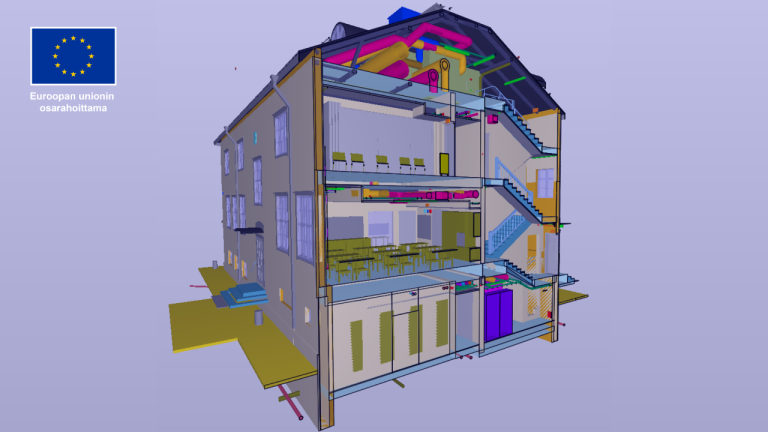
The Finnish perspective highlighted the same issue: every construction project generates massive amounts of sensor, design, and operational data, yet most of it remains scattered. Decisions are often based on incomplete or conflicting information even though the necessary data exists somewhere. This fragmentation — not technology — is the main bottleneck.
AI can unify these sources into coherent, real-time situational awareness. When datasets are linked systemically, their value multiplies. For example, snow-load sensor data becomes predictive when combined with maintenance schedules, fleet availability, and weather forecasts. In city planning, combining vitality, mobility, and building data reveals a dynamic urban model that supports evidence-based policy.
Three readiness pillars were repeatedly underscored:
- Mission & Outcome Focus — Technology follows strategy, not fashion.
- Workforce Readiness — Learning loops ensure human-AI feedback integration.
- Data Readiness — Clean, structured, and interoperable data is prerequisite.
These principles determine whether AI adds measurable value or remains a showcase.
3. From Pilots to Scale — Governance and Funding Define Success
Barcelona displayed an abundance of pilots and “what-if” simulations, yet many lacked clear ownership or financial models. Without predefined frameworks and shared governance, even the best pilots remain isolated.
Scaling requires a shared blueprint — organizational, ethical, and legislative conditions set before technical choices. Trust was identified as the decisive selection criterion: cities choose platforms and partners they can trust.
Successful implementations shared a dual governance structure:
- AI Innovation Hub for experimentation, MVPs, and ideation.
- AI Delivery Factory for scaling, iterative improvement, and continuous learning.
Without both, pilots collapse into silos — the very condition AI seeks to overcome.
4. Technological Outlook: Agents and End-to-End Analytics
AI technologies are converging toward agent-based ecosystems capable of full end-to-end analytics. NVIDIA presented “Physical AI” architectures, blending hardware acceleration with predictive urban analytics.
Microsoft and NVIDIA outlined a three-phase maturity model:
- Phase 1: Human with assistant
- Phase 2: Human-led agents
- Phase 3: Human-led, agent-operated
This Agent Maturity Path is rapidly becoming a cornerstone of public-sector AI strategy. 82% of surveyed leaders view 2025 as the inflection point when AI reshapes work, governance, and infrastructure.
5. Fragmented Knowledge as a Universal Problem
Across all industries, knowledge fragmentation is universal. Construction, like manufacturing and logistics, suffers from siloed information — systems, formats, and accountability chains that don’t align. AI’s fundamental role is to connect this knowledge base. When information flows seamlessly, automation, regulation compliance, and new business models emerge naturally.
In Finland, research at Tampere University frames AI as an infrastructural layer, not a single-point solution. The goal is to enable systemic linking of data — turning disconnected databases into a living, learning fabric that supports governance, urban planning, and operations. This approach aligns perfectly with the themes presented in Barcelona: standardization, observability, and trust as prerequisites for AI maturity.
Summary
Three directives define the next phase of intelligent urban development:
- Define the problem before the technology.
- Build strong data and legal infrastructure.
- Use transparent AI pilots to strengthen trust and accountability.
Technology is not the constraint — coordination is. Finland’s research and pilot projects demonstrate how data standardization and AI integration can turn fragmented knowledge into actionable intelligence, transforming cities from reactive systems into adaptive, learning infrastructures.