What led you to founding CHENEXT Technologies?
I had the idea for CHENEXT Technologies when I did my PhD at KU Leuven, and I participated in the prestigious EU-funded ETN-CHARMING project. They combined educationalists, game designers, chemists and chemical engineers together to explore the technologies of VR, AR and games to motivate and teach people. Our team worked on lifelong learning with the help of VR or AR in chemical industry. My case was to recreate a VR training demo for chemical lab safety, where the trainee needed to find all the dangers inside the lab and resolve them.
The project’s interdisciplinary research helped me learn about game making, motivation studies and how people learn in the context of VR and AR. It also made me understand that this is the technology of the future. Fuelled by this realisation, I founded CHENEXT Technologies in 2023 first on my own and later started the private liability company in 2024 with two other co-founders. Together with my two co-founders we have over 20 years of experience in the process industry and we make a very competent team. Our focus is on process industry, which means everything involving piping, valves, reactors – this also includes food industry, pharmaceuticals, waste treatments and water waste treatment.
What VR or AR -technologies do you use in your operations?
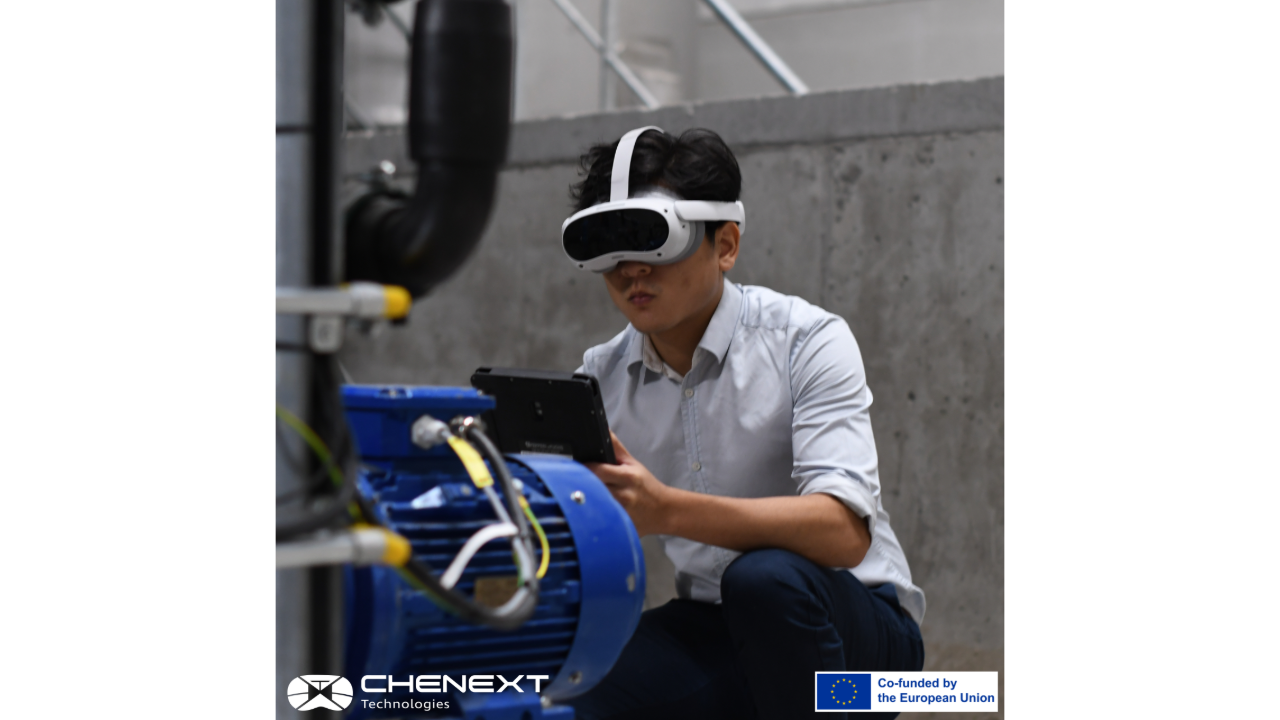
Our idea is to have multiple applications for multiple use cases inside the process industry, so we don’t only make VR or AR training, but we also provide visualizations during the whole lifecycle of the plant. For example, we have a plant review that lets you review the newly designed, life-size scaled plans inside VR. This allows customers to test their ergonomics and plans beforehand, which is very important in the high-risk process industry and saves them from a lot of costly errors in the long run.
Then again, during construction, we can visualise the newly designed plans from the 3D model on the construction field with AR-glasses, smartphones or tablets. This helps make the construction process preparations more visual and efficient. The 3D model also lets our customers train employees inside the new plants during construction, thus saving a lot of time. As an incentive, our VR training is very interactive and realistic, because we know what will happen and how the process will run.
Can you share more about how you teach people with different technologies?
Training is very important in the process industry’s high-risk environment, because the worker’s actions can have serious consequences if they don’t know what to do. This is why we offer the technology to virtually train employees. Additionally, training in VR is possible while the plant keeps running, unlike when training in the physical plant.
In most cases learning on the job also literally means following a senior employee during the job to gain knowledge and experience. However, nowadays the senior employees, who have 20-30 years of experience on the job, are nearing retirement. When they retire, the companies lose their tacit knowledge. Tacit knowledge is not explained during courses or in books, but when a senior employee shares it by word of mouth – if they have the time at all. If they retire, then all this knowledge disappears.
Thankfully we can save their experience in an immersive way into virtual on-the-job training. There a virtual person guides the trainee along the virtual plant, like in real life, but the path is saved and it can be re-looped to view the important sections again. A good real-life example could be, when a company needs to train a trainee to use a compressor machine, but it was fabricated by another company that’s in another country. To get the training, the person would need to travel to another country for every training and maintenance, which is costly. However, we can solve this with virtual technology and training, where they can digitally save the training or adapt it further into interactive true-to-life training that is now possible with XR technologies.
Can you tell about digital twins in your operations?
First it should be said that there are many definitions of digital twins in the world, and people get confused what a digital twin actually is. In my definition, first we have a 3D digital copy of the plant, that is still static. This is called the digital model. When we add smart data into it, it starts to communicate the reality of the plant to the 3D model. This is called the digital shadow, because it is a shadow of the plant’s reality communicated through pressure sensors and temperature measurements, for example. In a digital shadow all the real data is up to date in the 3D model.
A true digital twin means that the information can also be sent from the 3D model to reality. It is a two-way communication system between the reality and the digital. For now, in the process industry, we have controlling systems that are mostly on a computer screen with a 2D diagram. The plant’s valves and reality can then be controlled through it. However, a true digital twin would be inside a 3D model, and you could control assets from your digital space. Nevertheless, it will still take some time until the technology gets up to that level.
How much do your VR and AR applications cost?
Our prices depend on variables like how large and complex the project is, what specifics it has and how long it takes to develop. CHENEXT Technologies’ business model includes a licence of about 2000 euros per year per person. The licence is then used for developing and updating all the features that are valuable and usable for our companies. Eventually this means that we don’t need to build everything from scratch every time, or project per project.
At the beginning, the setup fee can be from 10,000 to 25,000 euros depending on how complex the plant is. If it’s very complex, it can even be in the range of 50 to 100 thousand. These prices are not set in stone but depend on what the client needs as well. Even though it can be a large sum, it also saves a lot of money in the long term. A company can save hundreds of thousands of euros just because they can find and fix an error early.
What new technologies do you look forward to the most?
I’m looking forward to mature and light Smart Glasses that we can also use at CHENEXT in the future. There is still a gap for see-through AR glasses in the construction industry, for example. There are already display AI glasses with small cameras on them, but we are waiting for the next big hardware producer to make light variables that can be used the whole day. The glasses should also include the technology to see through the environment around the user and not close it off like they do with pass-throughs. I hope to have these types of AR Smart Glasses soon, so we can also start developing new products for it.
More information:
Philippe Chan, PhD
Founder
CHENEXT Technologies
philippe.chan@chenext.com
Tampere University and Häme University of Applied Sciences’ co-project Digital tools for intelligent design (SmartDesign) is funded by the European Regional Development Fund (ERDF). The Council of Tampere Region and the Regional Council of Häme granted the funding. The project is co-funded by the European Union.