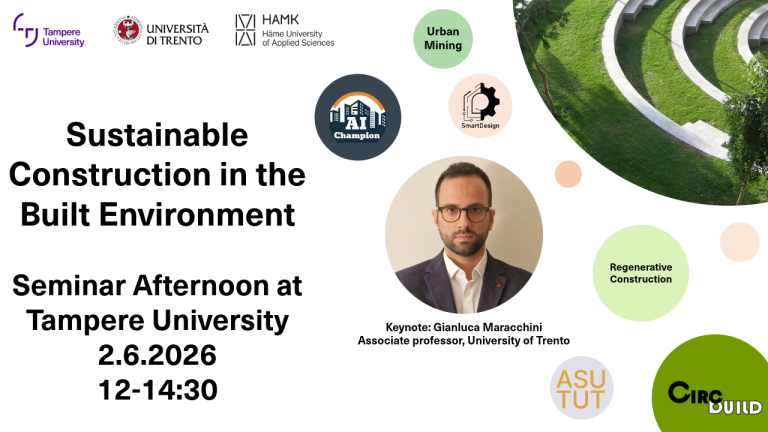

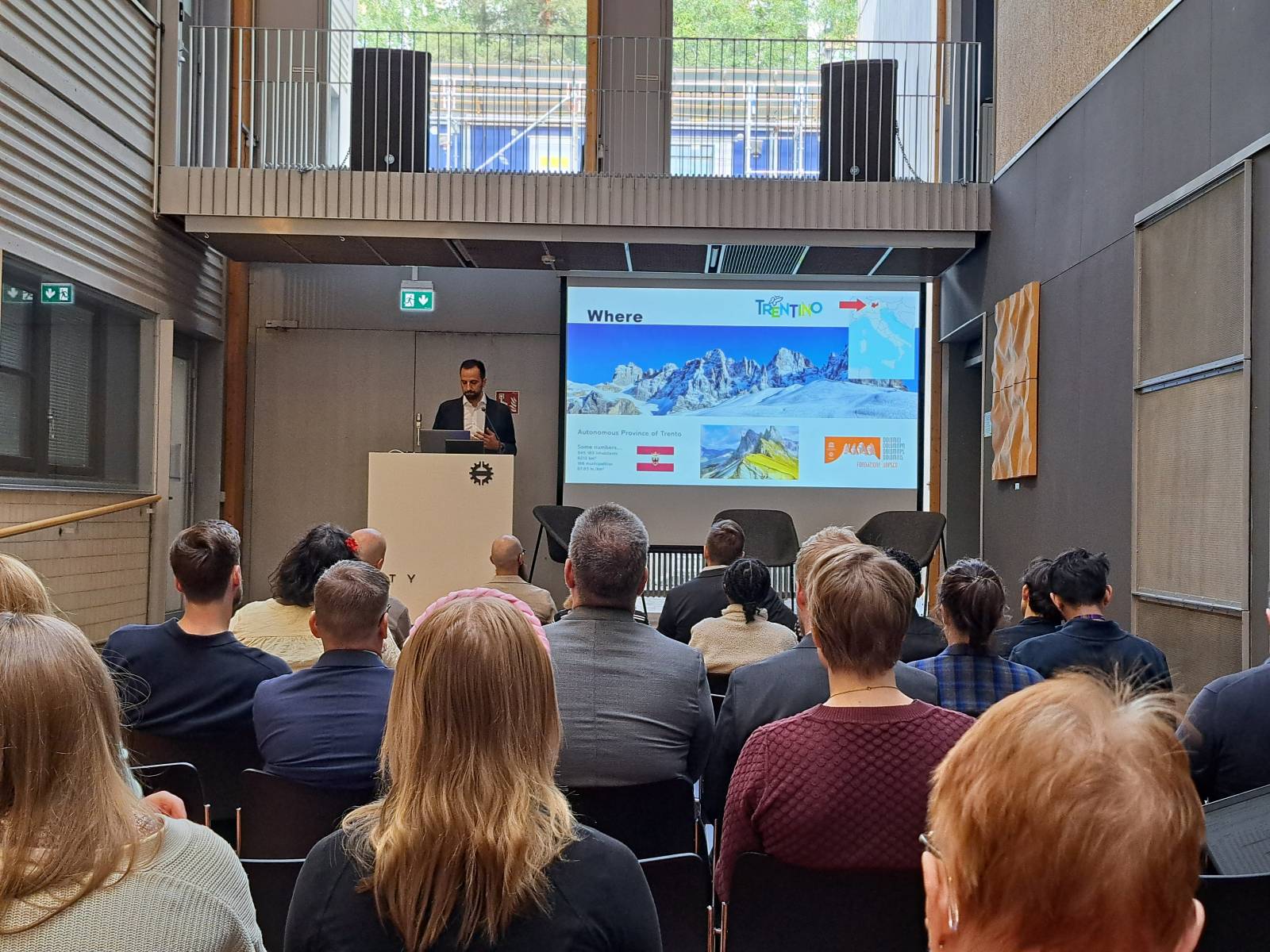
The Seminar Afternoon gathered together interested parties in sustainable construction. As a highlight of the event, we heard Associate Professor Gianluca Maracchini’s keynote that bound together the themes of sustainability, circularity and resilience in the construction landscape in Northern Italy.
“In Trento, our research focuses on the transformation of the built environment under the combined pressures of climate change, energy transition and the need for circularity. In the Italian context, this means working on an existing building stock that is old, energy-intensive and often exposed to seismic risk. For this reason, we cannot look at energy efficiency alone: we need integrated strategies that combine decarbonisation, seismic safety, circularity and climate resilience,” says Maracchini.
“A key message of my lecture was that sustainability in construction is no longer only about reducing operational energy. We need to consider the whole life cycle of buildings, including embodied carbon, future climate conditions, extreme events, and the possibility to reuse materials and components. In this sense, circular design and design for disassembly become essential tools for reducing impacts and creating more adaptable buildings,” continues Maracchini.
Alongside solutions, it is imperative to think about the lifecycles of buildings and what the scale of the project is. There is an emerging need to look at larger and larger areas instead of singular buildings or project sites. A good example arose in the Regenerative Construction project’s workshop, where attendees wanted to find city-wide applications that would have a greater effect on climate change.
From research exchange to counter visits and future funding applications
The visits and research collaboration started last Summer, when Doctoral Researcher Juha Franssila from the Knowledge Centre for Real Estate Development (KCRED) research group was looking for a research exchange university in Europe. His research focuses on environmental sustainability and circularity activities in the construction and real estate industries, which aligns well with the University of Trento’s research aims. Both universities are also part of the European Consortium of innovative Universities (ECIU), which is a network that helps unite research-intensive institutions to foster innovation and entrepreneurship.
“The collaboration with Tampere University started in a very natural way, through common research interests. Juha’s visit to Trento gave us the opportunity to discuss shared challenges related to timber construction, renovation processes, value networks and the transition towards more sustainable real estate development,” says Maracchini.
“What I found particularly valuable is that our universities approach similar questions from complementary perspectives. In Trento, we work on climate adaptation, building environmental performance and circular construction systems, while Tampere brings important expertise on the real estate development process and understanding the industry’s sustainability transition. This creates a very promising basis for joint research, student exchange and future funding applications,” adds Maracchini.
“The two universities have clear synergies that provide several avenues for future collaboration. In the short term, we are exchanging ideas and developing joint publication projects. The ECIU has provided an excellent opportunity for short research exchange visits, which have already resulted in concrete outcomes. The next research exchange in Trento has already been planned for the beginning of 2027,” says Franssila.
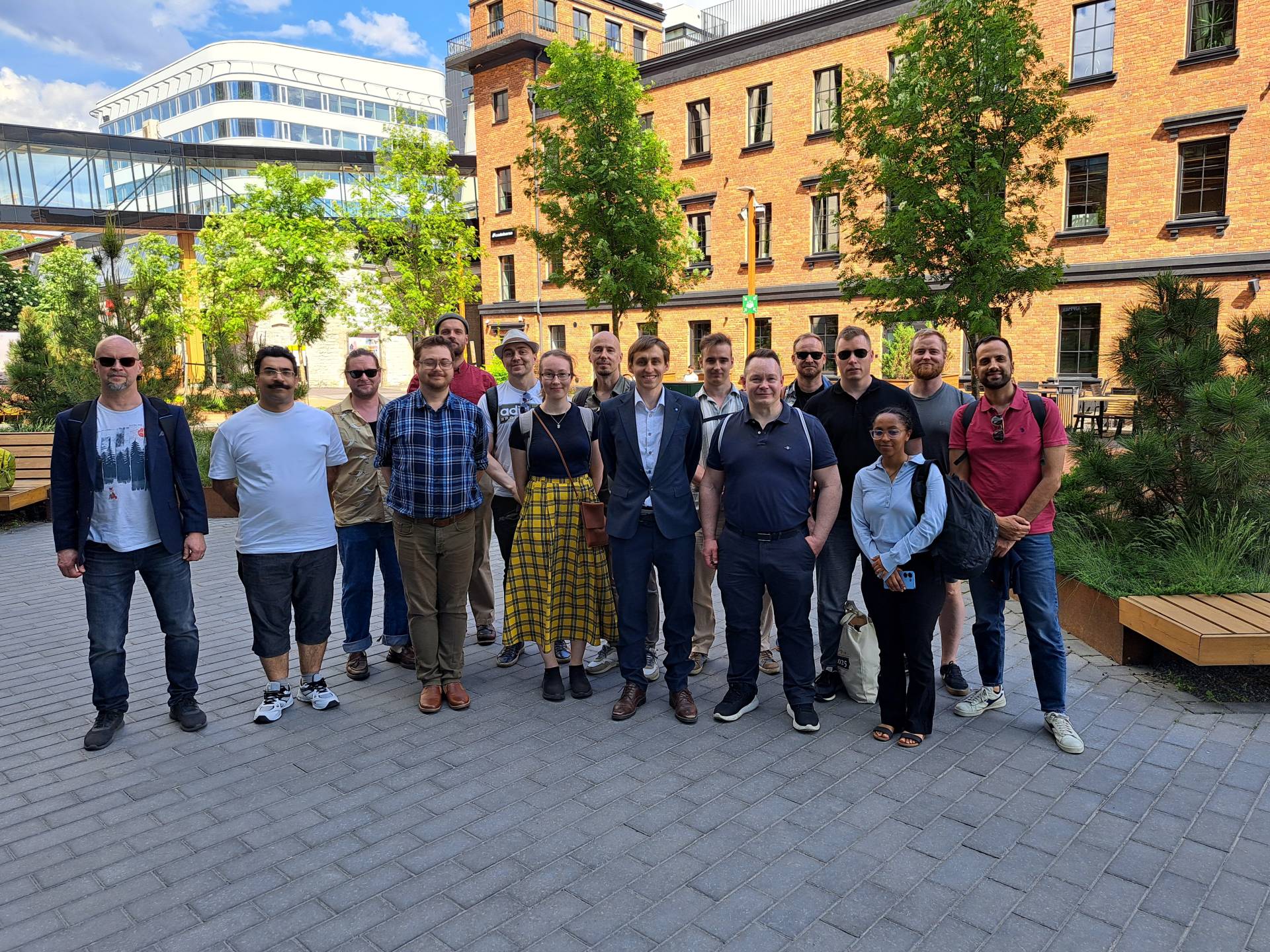
A short trip to Tallinn for real estate development visit and networking
The KCRED research group concluded Associate Professor Maracchini’s first week in Finland with a visit to Estonia. The research group gathers every year for a summer days event that allows the two dozen researchers to share their findings, ideas and research. This year the summer days were spent in Tallinn to visit the innovation district Ülemiste City and their first ever saunafestival. Ülemiste City has many interesting aspects for many of the KCRED’s research projects.
“Ülemiste City showed how innovation districts can become real laboratories for testing new forms of urban development, collaboration and sustainability at the district scale”, says Maracchini.
“For the next steps, I see strong potential in developing joint research activities between Trento and Tampere on circular and climate-resilient construction, with a particular focus on timber systems, renovation strategies, design for disassembly and the evaluation of environmental impacts over the full life cycle. The challenges we face are shared across Europe, and this makes cross-border collaboration not only useful, but necessary”, concludes Maracchini
More information:
Gianluca Maracchini
Associate Professor
University of Trento
gianluca.maracchini@unitn.it
Juha Franssila
Doctoral Researcher
Tampere University
juha.franssila@tuni.fi
Text and photo:
Alisa Hakola
Researcher
Tampere University
alisa.hakola@tuni.fi