

Why laboratory teaching needs room for uncertainty
Laboratory engineering students need more than the ability to follow a validated procedure. In working life, they must also judge unfamiliar situations, adjust instruments responsibly, and solve problems when the next step is not fully specified. This article describes an open-ended HPLC (High Performance Liquid Chromatography) laboratory exercise at Tampere University of Applied Sciences and what was learned from its first implementation.
At the laboratory engineering education in Tampere University of Applied Sciences, in conventional instrumental analysis exercises, students often work independently with analytical instruments, but their choices are supported by quite detailed instructions. This structure is important for learning safe routines and analytical practices. However, it may leave a gap between routine operations and skills needed e.g. in method development, where students must select parameters, interpret imperfect results, and decide how to proceed.
This challenge is also addressed in TechLit, an Erasmus+ cooperation project that develops new approaches to teaching digital and technological literacy in biomedical laboratory science, laboratory engineering and radiography. The project brings together educational institutions from Finland, Denmark, the Netherlands and Norway. It shares teaching practices, engages representatives of professional fields in co-development, and develops cross-curricular approaches that prepare students not only to use technology but also to participate actively in technological development. (Tampere University of Applied Sciences (TAMK), N.d.).
A competence survey conducted within the TechLit project, together with feedback from working life, highlighted the need for students to operate unfamiliar analytical instruments independently and apply strong problem-solving skills. Similarly, previous research suggests that although students may be competent in using common laboratory instruments, they often need further development in higher-level skills such as experimental design, decision-making and problem-solving in open-ended situations (Mistry & Gorman, 2020). Laboratory learning can also promote higher-order thinking and understanding and outcomes such as confidence, in addition to experimental competence (Agustian et al., 2022). Structured problem-based laboratory activities can further strengthen confidence and conceptual understanding while developing students’ ability to analyze data, recognize methodological limitations and select appropriate techniques for specific problems (Valsecchi et al., 2024).
An exploratory HPLC exercise
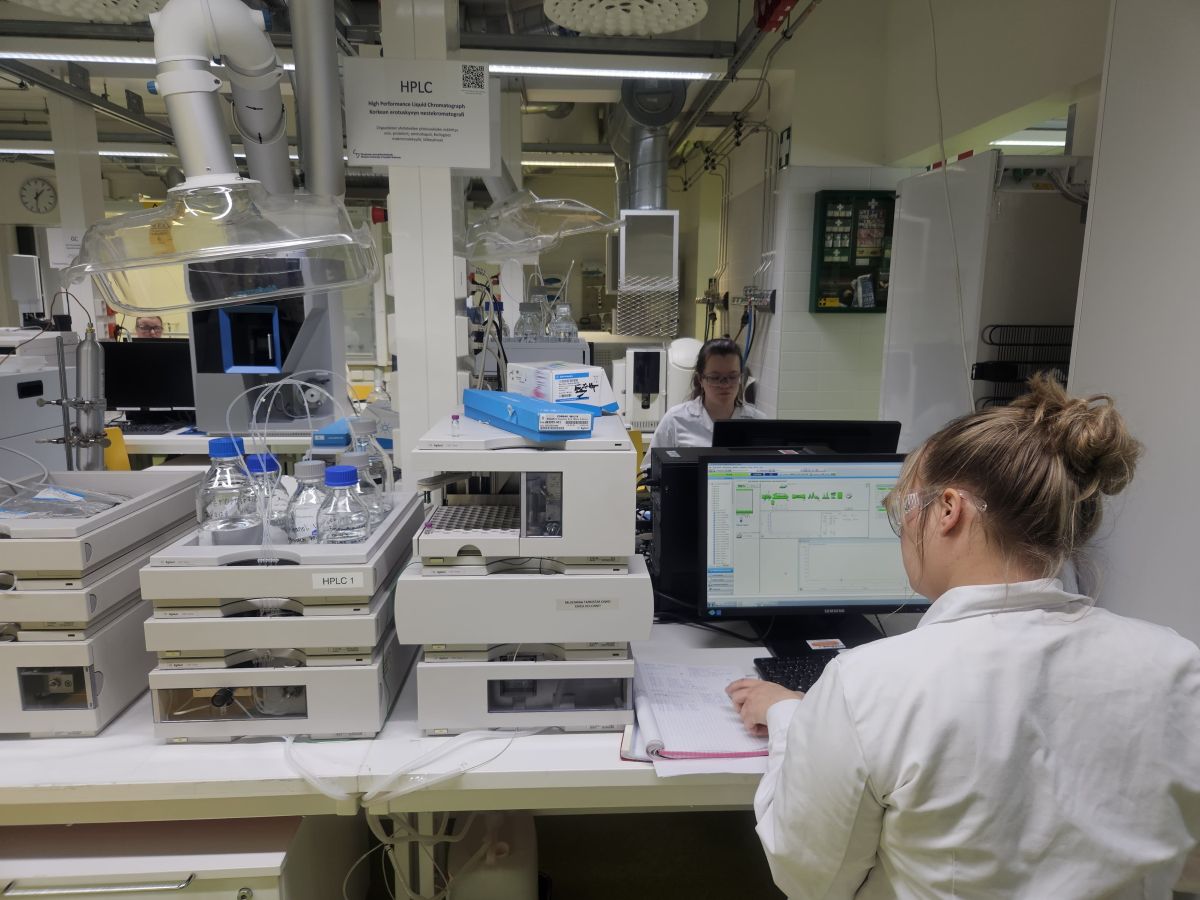
New laboratory experiment was designed and piloted in TechLit project to improve the curriculum-level transition from instructed instrument use to the greater autonomy required in method development course. The pilot was implemented with second-year laboratory engineering students who had previously used high-performance liquid chromatography (HPLC), but had limited experience of open-ended instrument work. The exercise consisted of preliminary questions, a six-hour laboratory session and reporting. To evaluate the exercise pilot, students completed questionnaires before and after the pilot, while teachers observed their work throughout the laboratory session.
Instead of receiving one complete method instruction and a fixed sequence of steps, student pairs planned initial settings and investigated how selected parameters affected chromatographic performance. The parameters included the column type, mobile-phase composition, flow rate, column temperature, detection wavelength and injection volume. Students were expected to change one parameter at a time, compare chromatograms and revise their plans in response to the results. The exercise also introduced tasks that were new to many students, such as changing the column.
The teacher’s role was deliberately different from normal laboratory exercise. Guidance remained available for safety and technical questions, but students were encouraged to make experimental choices themselves.
Initial uncertainty turned into active experimentation
At the beginning, students were unsure how to approach a task that did not define every step. In the pre-questionnaire, 75% reported feeling somewhat unconfident before starting. Part of this uncertainty arose because the instructions did not state clearly enough that completing every proposed task was neither expected nor possible within the available time.
Student pairs tested parameter settings independently, discussed alternatives and adjusted their plans. By the end of the session, many wanted to continue experimenting beyond the scheduled class time.
As the session progressed and the students became more familiar with the instrument, the workflow changed. Student pairs tested parameter settings independently, discussed alternatives and adjusted their plans. By the end of the session, many wanted to continue experimenting beyond the scheduled class time. Students reported that adjusting parameters felt less risky once they understood that exploration was expected and that carefully considered changes could be made safely.
The post-questionnaire and teacher observations suggest that the exercise supported both understanding of chromatography, HPLC technique and practical learning. Students felt that they understood how HPLC parameters influence chromatographic performance and that exercise strengthened their ability to respond to unexpected problems. After the session, 75% reported feeling confident about working with laboratory instruments when the task was not fully defined in advance. Students also considered the exercise more demanding in terms of independent thinking than their previous HPLC work. Pair work was described as helpful for planning, communication and troubleshooting.
These findings should nevertheless be interpreted as feedback from a teaching pilot rather than evidence of general effectiveness. The questionnaires captured the students’ immediate experiences, while the available material does not report a comparison group or a longer-term assessment of competence. A future implementation could therefore examine whether the confidence and decision-making practiced in the exercise transfer to later method-development tasks. The pilot setting had limitations like availability of instruments and students for testing.
What should be changed next?
The main area for development is how exercise is framed for students. Open-ended learning does not mean unclear learning. Students should be told before the laboratory day that the list of possible tests is intentionally broader than can be completed, that they may choose their own route and that reasoned experimentation is an explicit learning objective. The preparatory questions were valued and should be retained because they offer structure without prescribing every decision.
Time should also be reserved for the activities that best support the learning objective. During the pilot, a substantial part of the six-hour session was spent becoming familiar with the instrument and preparing solutions. Preparing selected stock solutions in advance would create more time for parameter testing, interpretation and hands-on instrument work. The number of possible parameters does not necessarily need to be reduced, because choosing what to test is part of the exercise. Instead, the instructions should give students explicit permission to prioritise.
The exercise may also fit better later in the instrumental analysis study path, once basic HPLC operation is familiar. At that stage, students can focus less on instrument navigation and more on interpreting parameter effects, changing columns and using more advanced instrument functions. Based on the pilot feedback, the exercise instructions will be revised and the exercise tested with students who have more previous HPLC experience
Courage is a competence that can be practiced
Courage in the laboratory does not mean taking careless risks. It means being willing to make reasoned decisions and move the work forward in less structured tasks, such as method development, while recognizing the limits of one’s competence and seeking guidance whenever safety is uncertain. A carefully framed open-ended exercise can provide a setting for practicing this combination of responsibility and curiosity.
Instructions should secure safe work and analytical quality, but they should also leave enough room for students to think, choose and learn from results that were not predicted in advance.
The first pilot suggests that students can move from uncertainty towards purposeful experimentation when the expectations become clear and support remains available. For laboratory education, the lesson is practical: instructions should secure safe work and analytical quality, but they should also leave enough room for students to think, choose and learn from results that were not predicted in advance. This conclusion is consistent with the pilot summary, which reports positive engagement and learning potential while identifying time, preparation and curriculum placement as targets for further development.
Generative AI was used to support language editing. The author reviewed and revised the content and is responsible for the accuracy of the manuscript.
References
Agustian, H. Y., Finne, L. T., Jørgensen, J. T., Pedersen, M. I., Christiansen, F. V., Gammelgaard, B., & Nielsen, J. A. (2022). Learning outcomes of university chemistry teaching in laboratories: A systematic review of empirical literature. Review of Education, 10, e3360.
https://doi.org/10.1002/rev3.3360
Mistry, N. & Gorman, S. G. 2020. What laboratory skills do students think they possess at the start of university? Chemistry Education Research and Practice, 21, 823–838. https://doi.org/10.1039/C9RP00104B
Tampere University of Applied Sciences (TAMK), N.d. Technological literacy for lab and health technology professionals. Project description. Read 2 October 2026. https://www.tuni.fi/en/tamk/research-development-and-innovations/technological-literacy-lab-and-health-technology
Valsecchi, W. M., Delfino, J. M., Santos, J. & Faraj, S. E. 2024. A problem-based learning activity for enhancing inquiry skills and facilitating conceptual change in a biological chemistry course. Chemistry Education Research and Practice 25(2), 438–457. https://doi.org/10.1039/D3RP00053B
Author
Piia Kanto
Senior Lecturer
Faculty of Built Environment and Bioeconomy
Tampere University of Applied Sciences
piia.kanto@tuni.fi
ORCID: 0009-0007-3197-0076
Photo: Students participating in the pilot work with HPLC instruments (Photograph: Piia Kanto)