

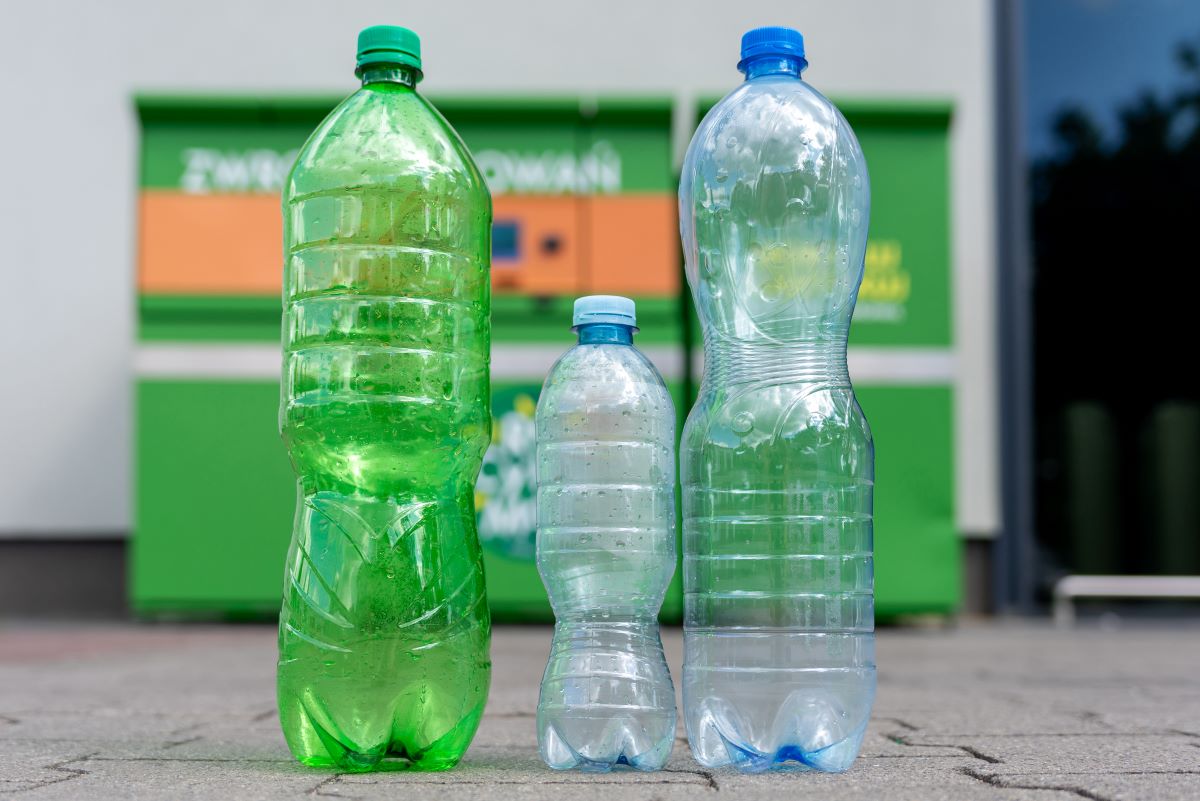
Introduction and justification of consumers’ role in packaging design
Different kinds of packages are an integral part of our daily lives in modern society. Packaging has also a key role when solving the plastics challenge and advancing circular economy in the European Union (EU). Packaging is one of the key value chains in the EU’s Circular Economy Action Plan (COM 2020/98/EU) implementing the European Green Deal (COM 2019/640/EU). In coming years, Packaging and Packaging waste regulation (PPWR) aims to put the sector on track with climate neutrality by 2050 by minimizing the quantities of packaging and waste and lowering the use of raw materials (Regulation 2025/40/EU).
Recent research literature highlights the importance of including consumer perspectives in packaging design to support the acceptance of circular solutions and engagement with the circular economy. In packaging, the circular economy R strategies (Kirchherr et al. 2017) are mainly applied by avoiding packaging (Refuse), developing sustainable concepts (Rethink), reducing material and energy intensity (Reduce), enabling multiple use cycles (Reuse), and recycling packaging materials (Recycle) (Corona et al. 2024). In a systematic literature review by Gomes et al. (2022), the authors emphasize the central role of consumers in circular consumption systems and identified six circular mindsets, 14 circular behaviors, and 54 influencing factors, which serve as indicators of the complexity of the topic. A study by Williams et al. (2020) showed that the packaging of some food products can help reduce household food waste, particularly through appropriate package size and clear information on product safety and storage. Zhu et al. (2022) stressed that designers should communicate the positive impacts of products and packaging in ways that motivate consumers to recycle and presented a circular packaging design framework extending from material selection to design validation with tools such as life-cycle assessment (LCA). Although consumers are crucial to the end-of-life success of circular strategies, their behavior is still not widely incorporated into LCAs of packaging solutions (Corona et al., 2024).
This article reports on a focus group discussion with a Namibian university staff and students, who had a role as Namibian consumers. It offers a valuable consumer perspective from outside of Europe on selected Finnish packaging solutions representing three different circular economy strategies (Recycle, Reuse, Rethink). The results are discussed mainly in terms of what motivates or hinders the use of these solutions in everyday life. Perspectives emerging from the discussion are also considered in conclusion.
Focus group discussion targeting on four Finnish packaging solutions
Four Finnish circular packaging innovations representing three different circular economy strategies were discussed in the focus group (Figure 1). The first circular packaging solution was a refillable 0.5-litre spray bottle accompanied by two tablets, which, by dissolving them in water, results in 2 x 0.5-litre dose of detergent (rethink). The second one was Palpa deposit beverage bottle (PET) (Recycle), the third one was a fiber-based reusable shopping bag (Reuse), and the fourth one was a reusable e-commerce packaging (Reuse).
The used research method, focus group discussion, is defined by Barbour (2007) as follows: ‘A group convened for research purposes that relies on data on the discussion generated between participants.’ Focus groups are particularly suitable for exploring participants’ knowledge, experiences, and attitudes because the method uses group interaction to generate data and helps participants clarify their views through discussion (Kitzinger, 1995).
The focus group discussion was connected to two packaging RDI projects. The BioPak (Sustainable packaging solutions of the bio-circular economy) project aims at developing innovative take-back and reuse concepts of fibre-based packaging, with the consumer perspective in mind. This objective includes the development of resource-efficient wood fibre packaging and microplastic-free recycling processes. The ResPA (Consumers’ role in responsible packaging) aims at improving circular economy innovation capacities in packaging value chain actors and emphasize the consumer’s role in the circular economy.
The focus group discussion involved eight participants from Namibian higher education community representing both staff members and master’s level students. Although the group represented academically oriented residents of Namibia, it was underlined that in the focus group discussion they represented Namibian consumers. The discussion had a moderator and a note taker who used a pre-designed framework for picking up engagement expressions (motivator or driver for the consumer to use the solution as well as improvement ideas/suggestions), hindering expressions (something which makes the consumer question the solution), and other relevant remarks. The recorded discussion (47 minutes) was transcribed and the notes complemented by using both the recording and the transcription.
Staff and student exchange from Namibia to Finland were part of CircBioNam (Promoting circular bioeconomy in higher education by sharing and refining best practices in Finnish-Namibian collaboration) which is funded by Team Finland Knowledge (TFK) programme and ProCE (Finnish – Namibian Academy-Industry Consortium for Promoting Circular Economy) funded by Erasmus+ KA171. Both projects are implemented in Namibia and Finland 2025-2027.
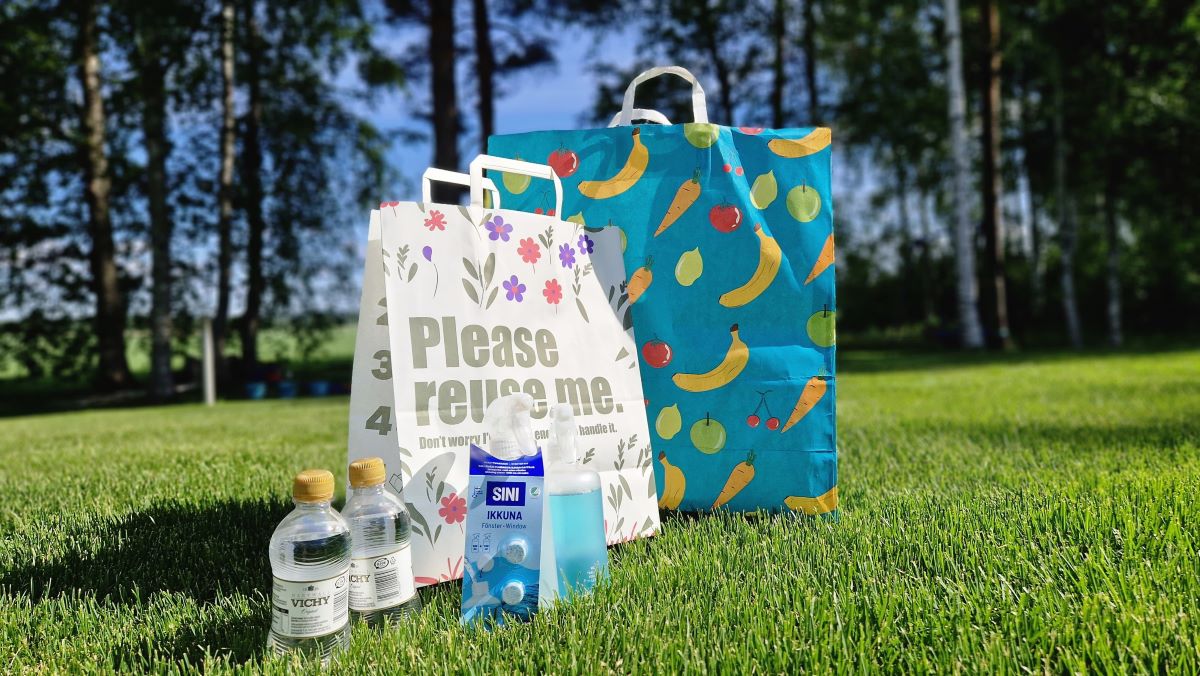
Figure 1 Circular packaging solutions used in a focus group discussion: from left to right, Palpa deposit beverage bottle (PET), a refillable 0.5-litre spray bottle accompanied by two tablets, and fiber based reusable shopping bags (Photo: Nina Kukkasniemi)
Identified engagement elements and hindering topics
Recycling system for beverage bottles
The Palpa deposit beverage bottle (PET) system received several engagement expressions in the focus group discussion. It was described as a fun, easy, convenient, and exciting concept and underlined that monetary value is encouraging. It was also pointed out that return points for the bottles need to be easily accessible.
“For me, I had the feeling that I had my drink for free. Because you get the bottle’s price back again. It’s nice that you had it this way. And definitely reducing waste.”
The focus group discussion brought up that applying a similar kind of system to Namibia might face a socio-cultural challenge because collecting PET bottles is associated with low-income population and poverty.
Rethink by refilling
The refillable bottle accompanied by tablets for refilling was considered a familiar and nice concept but was questioned because the tablets were wrapped in plastic and there were only two tablets in the package. This causes the need to purchase tablets for refilling rather often, resulting in unnecessary packaging waste. The suggested solution to the problem was, for example, using paper bags instead of plastic, and that more tablets could be purchased at the same time. It was underlined that refillable bottles are already in use when empty bottles are reused to, for example, dilute detergents.
“Like I said, where you just make the tablets available in bulk and then the consumer decides how many tablets they are taking at a time.”
The ‘rethink’ of the solution was challenged in the focus group discussion because it was not perceived as particularly novel and participants highlighted that a similar approach is already common in concentrate-based models, where consumers routinely mix and prepare suitable, often nature-friendly cleaning solutions themselves using existing spray bottles at home. Thus, the concept was seen as a variation of an established practice rather than a fundamentally new solution.
Reusable solutions
The fiber-based reusable shopping bag collected quite doubtful arguments in the focus group discussion. The good quality of the product was seen as promising, but still of concern was the durability of the bag based on the bad experience of paper-made shopping bags.
“But maybe it can be used for, let’s say, vegetables, something light, lettuce, something small.”
In addition, the price of the product, its availability and end-of-life were discussed. Overall, existing canvas shopping bags were considered a convenient and durable alternative for ‘plastic bag-free’ shopping.
Reusable e-commerce packaging as a concept raised many practical questions although the basic idea was considered reasonable. Participants pointed out that in Namibia, online shopping is rather expensive due to taxation and the discussion stayed on an academic rather than practical, daily life, level.
“But I do like the system of returning it and then you get a coupon that is an incentive that will definitely encourage people to use them.”
Circularity in packaging solutions should be easily implemented
Consumers should have an important role in packaging design because, in the end, they decide if circularity is realized or not, i.e. if packaging waste is sorted and recycled properly, and whether systems and new materials are accepted or not (e.g. Gomes et al., 2022). The focus group discussion provided valuable consumer insights by asking what engages and what hinders participants on different circular packaging solutions representing the three different circular economy strategies: Recycle, Rethink, and Reuse.
Despite cultural and societal differences between Finland and Namibia, packaging solutions with circular economy potential tend to be properly used and sorted when they are sufficiently convenient and reliable in everyday life and do not require additional effort from consumers.
A key finding was that despite cultural and societal differences between Finland and Namibia, packaging solutions with circular economy potential tend to be properly used and sorted when they are sufficiently convenient and reliable in everyday life and do not require additional effort from consumers. Economic feasibility as well as environmental and cultural aspects were also emphasized in the discussion. Although the current connection between poverty and the collection of empty bottles might hinder the implementation of a Palpa –style deposit beverage bottle (PET) system in Namibia, the circular economy for PET bottles has advanced in Namibia. Community Recycling Heroes –project offered training for unemployed women to collect and sell recyclables, which gave them a chance to get employed and empowered (Namibia Economist, 2023, Lappi & Kostia, 2025).
Discussion brought out that small-scale production of cleaning agents can contribute to reduced packaging waste, when consumers are using the same packaging several times. This can be considered prosumerism, which combines the roles of a producer and a consumer. Only a few generations ago this was mainstream in Finland and broadly in use in Namibia. An interesting question is, could we learn from these earlier daily life models and modernize them for today’s business context? Are companies ready to challenge their innovation processes, and rethink existing solutions and better respond to evolving consumer needs in circular packaging solutions?
References
Barbour, R. (2007), Doing Focus Groups, SAGE Publications Ltd. https://doi.org/10.4135/9781849208956
Corona, B., Tunn, V.S.C. & van den Broek, K.L. (2024). Integrating consumer behaviour into the environmental assessment of circular packaging: a scoping review. Int J Life Cycle Assess 29, 80–98. https://doi.org/10.1007/s11367-023-02218-1
COM 2019/640/EU. The European Green Deal. https://eur-lex.europa.eu/legal-content/EN/TXT/PDF/?uri=CELEX:52019DC0640
COM 2020/98/EU. A new Circular Economy Action Plan For a cleaner and more competitive Europe. https://eur-lex.europa.eu/legal-content/EN/TXT/?qid=1583933814386&uri=COM:2020:98:FIN.
Gomes, G. M., Moreira, N., & Ometto, A. R. (2022). Role of consumer mindsets, behaviour, and influencing factors in circular consumption systems: A systematic review. Sustainable Production and Consumption, 32, 1–14. https://doi.org/10.1016/j.spc.2022.04.005
Kirchherr, J., Reike, D, & Hekkert, M. (2017). Conceptualizing the circular economy: An analysis of 114 definitions. Resources, Conservation and Recycling 127, 221-232. https://doi.org/10.1016/j.resconrec.2017.09.005
Kitzinger, J. (1995). Qualitative research: Introducing focus groups. BMJ, 311(7000), 299–302. https://doi.org/10.1136/bmj.311.7000.299
Lappi, J. & Kostia, S. (2025). Circular economy needs and opportunities in Namibia. In Silja Kostia and Sonja Tiitola (ed) Co-Developing in Namibia for Circular Economy Capacity Building and Business Model Mapping .Tampereen ammattikorkeakoulun julkaisuja. Sarja B. Raportteja 164.
Namibia Economist. Published Sep 7, 2023. Women trained to collect recyclables for on-selling to waste processors. https://economist.com.na/82359/businesswoman/project-to-empower-women-through-recycling-initiative-as-a-means-of-income-generation/
Regulation 2025/40/EU. Regulation on packaging and packaging waste https://eur-lex.europa.eu/legal-content/EN/TXT/PDF/?uri=OJ:L_202500040
Williams, H., Lindström, A., Trischler, J., Wikström, F. & Rowe, Z. (2020). Avoiding food becoming waste in households – The role of packaging in consumers’ practices across different food categories. Journal of Cleaner Production 265, 121775. https://doi.org/10.1016/j.jclepro.2020.121775
Zhu, Z., Liu, W., Ye, S. & Batista, L. (2022). Packaging design for the circular economy: A systematic review. Sustainable Production and Consumption 32, 817-832. https://doi.org/10.1016/j.spc.2022.06.005
Authors
Silja Kostia
Principal Lecturer
Faculty of Built Environment and Bioeconomy
Tampere University of Applied Sciences
silja.kostia@tuni.fi
ORCID: 0000-0002-8980-4640
Nina Kukkasniemi
Senior Lecturer
Faculty of Built Environment and Bioeconomy
Tampere University of Applied Sciences
nina.kukkasniemi@tuni.fi
ORCID: 0009-0008-1200-8380
Kirsi Linkosuonio
Project Person
Faculty of Built Environment and Bioeconomy
Tampere University of Applied Sciences
kirsi.linkosuonio@tuni.fi
ORCID: 0009-0004-6683-8890
Photo: Adobe Stock