

Learner-centred pedagogy is based on the idea that learning is most effective when students actively construct knowledge through participation, interaction, reflection and meaningful engagement rather than through passive reception of information. Instead of positioning the teacher primarily as a transmitter of knowledge, learner-centred approaches emphasise the teacher’s role as a facilitator, guide and designer of learning environments that support students’ autonomy, collaboration and individual learning processes. The theoretical roots of learner-centred pedagogy can be linked to constructivist learning theories, particularly the work of Dewey (1986), Vygotsky (1978), and later social constructivist perspectives emphasising interaction and contextual learning. In higher education, learner-centred pedagogy has also been associated with active learning, authentic assessment and reflective practice, especially in blended and technology-enhanced learning environments (Weimer, 2013; Biggs, 2011). At the same time, recent discussions have highlighted that learner-centred pedagogy is not a single pedagogical model, but rather a broad framework that may be interpreted differently depending on educational culture, institutional context and teachers’ pedagogical beliefs.
Learner-centred pedagogy as a context-dependent concept
Recent research suggests that the term “learner-centred pedagogy” is interpreted inconsistently across the literature and educational contexts, with teachers often conceptualising it in different ways depending on local pedagogical traditions, beliefs, and institutional realities (Bremner, 2021). Because of these differences in interpretations across educational contexts, it is interesting to examine how teachers and teacher educators themselves understand the concept in practice. Rather than assuming a single shared definition, this article approaches learner-centred pedagogy as a context-dependent framework shaped by educational culture, institutional practices, and pedagogical beliefs. For this reason, the article explores both similarities and differences in how participants from Finland and Rwanda conceptualised learner-centred teaching during the workshop activities and discussions.
Workshop data from Finland and Rwanda
In spring 2026, experts from Tampere University of Applied Sciences (TAMK) facilitated a pedagogical workshop for teacher educators at Rwanda Polytechnic as part of the HEP-TED project. The project focuses on strengthening higher education pedagogy and teacher education practices through international collaboration, capacity building, and the development of learner-centred and technology-enhanced teaching approaches in Sub-Saharan Africa. The workshop focused on learner-centred teaching, blended learning, and emerging questions related to artificial intelligence in education. Through discussions, collaborative tasks, and a short survey, participants reflected on how learner-centred pedagogy is understood and implemented in their own contexts. A comparable dataset was also collected from a Finnish teacher education group. While the number of responses is relatively small and the findings should therefore be interpreted as a situational overview rather than a statistical study, the comparison offers interesting insights.
The following task was given to both the Finnish and the Rwandan participant groups during the workshops. Participants were asked the following question individually and then discussed their thoughts with a partner before writing down a short shared response anonymously on paper:
“What does learner-centred teaching (learner-centred pedagogy) mean to YOU in practice?”
The participants were instructed first to reflect on the question individually for five minutes and then discuss with their partner for another five minutes. After forming a joint understanding, they recorded briefly their shared thoughts anonymously. The purpose of the task was not to produce formal definitions, but to capture practical interpretations, experiences, and assumptions related to learner-centred teaching in different educational contexts.
In addition to the written workshop reflections, participants also completed a short anonymous Forms survey consisting of six Likert-scale statements related to learner-centred pedagogy and blended learning. The statements explored themes such as student autonomy, teacher–student relationships, peer collaboration, responsibility for learning, and the role of technology in learner-centred environments. The same survey was used with both the Finnish and the Rwandan participant groups in order to support comparison between contexts. Because the number of respondents was relatively small, the survey was not intended for statistical generalisation. Instead, it was used as a complementary tool for identifying tendencies, shared assumptions and differing perspectives related to learner-centred teaching.
The statements were:
- In blended learning, giving students more freedom over their learning paths does not always lead to better learning outcomes.
- A teacher can implement learner-centred teaching effectively even without knowing students personally.
- If students are not used to taking responsibility for their learning, learner-centred approaches may initially make learning more difficult for them.
- Technology in blended learning environments can both support and unintentionally weaken learner-centred pedagogy.
- Teachers may believe they are teaching in a learner-centred way even when students experience the course as teacher-centred.
- Peer collaboration in a blended learning environment leads to meaningful learning.
Complementary perspectives in the written responses and survey results
A total of 7 written response sheets were collected from the Finnish participant group and 5 from the Rwandan participant group. In addition, 12 anonymous Forms responses were collected from the Finnish participants and 15 from the Rwandan participants.
The written responses were analysed using a qualitative thematic approach. The analysis focused on recurring themes and interpretations related to learner-centred pedagogy, including the role of the teacher, student participation, collaboration, assessment, learning environment, and learner autonomy. The results of the thematic analysis are presented in Figure 1.
The Forms responses were analysed descriptively by examining response distributions and general tendencies rather than through statistical testing. The survey was used as a complementary source of evidence alongside the written workshop responses, helping to identify shared assumptions, differences in emphasis, and context-specific interpretations of learner-centred teaching.
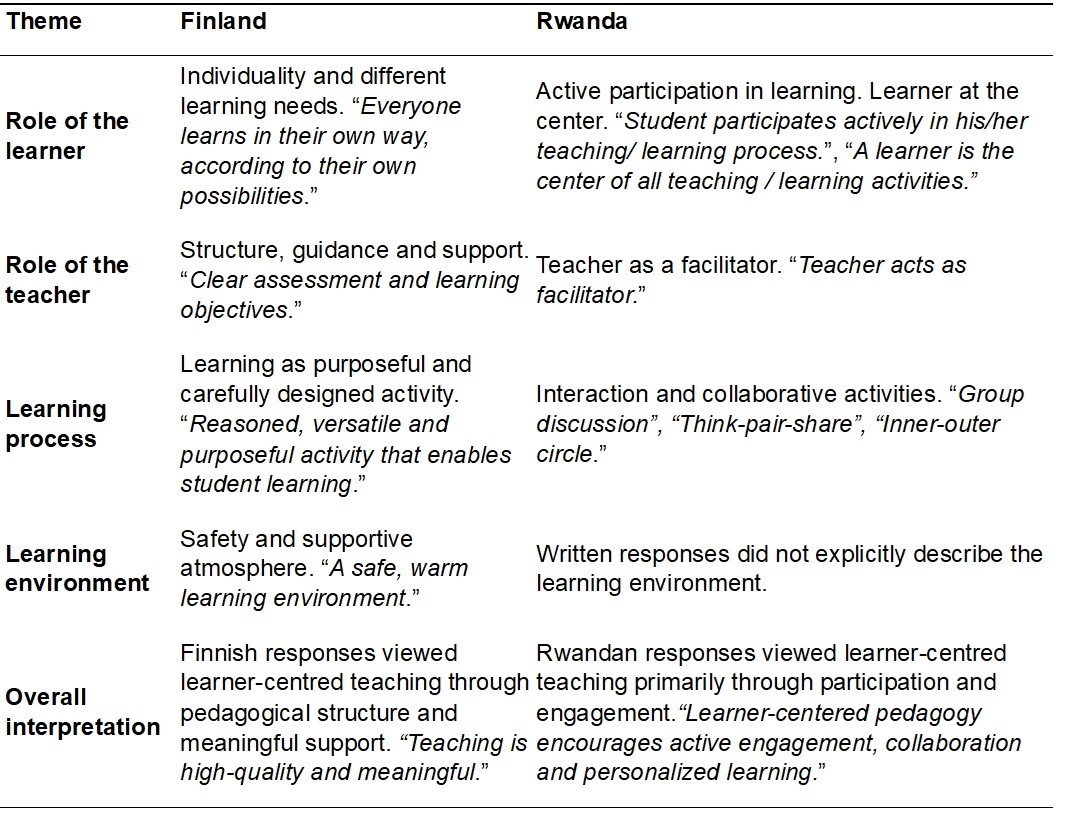
Figure 1 Thematic comparison of Finnish and Rwandan written responses related to learner-centred teaching
Figure 1 suggests that both groups shared the same broad commitment to learner-centred teaching, but approached it from partly different perspectives. The Finnish responses emphasised pedagogical design: individual learning needs, clear objectives, assessment, support, and a safe learning environment. In this sense, learner-centred teaching was understood as a structured and purposeful way of organising learning. The Rwandan responses, in turn, highlighted participation, interaction, and the active role of the learner. The teacher was described mainly as a facilitator, and learner-centred pedagogy was connected with collaborative methods such as group discussion, think-pair-square, and inner-outer circle. These perspectives are not contradictory, but complementary. Together they show that learner-centred teaching requires both meaningful participation and carefully designed structures that make participation possible.
The survey results (Figure 2) support the observations made from the written workshop responses. In both participant groups, learner-centred pedagogy was generally viewed positively, but the response patterns also revealed interesting differences in emphasis between the Finnish and the Rwandan groups.
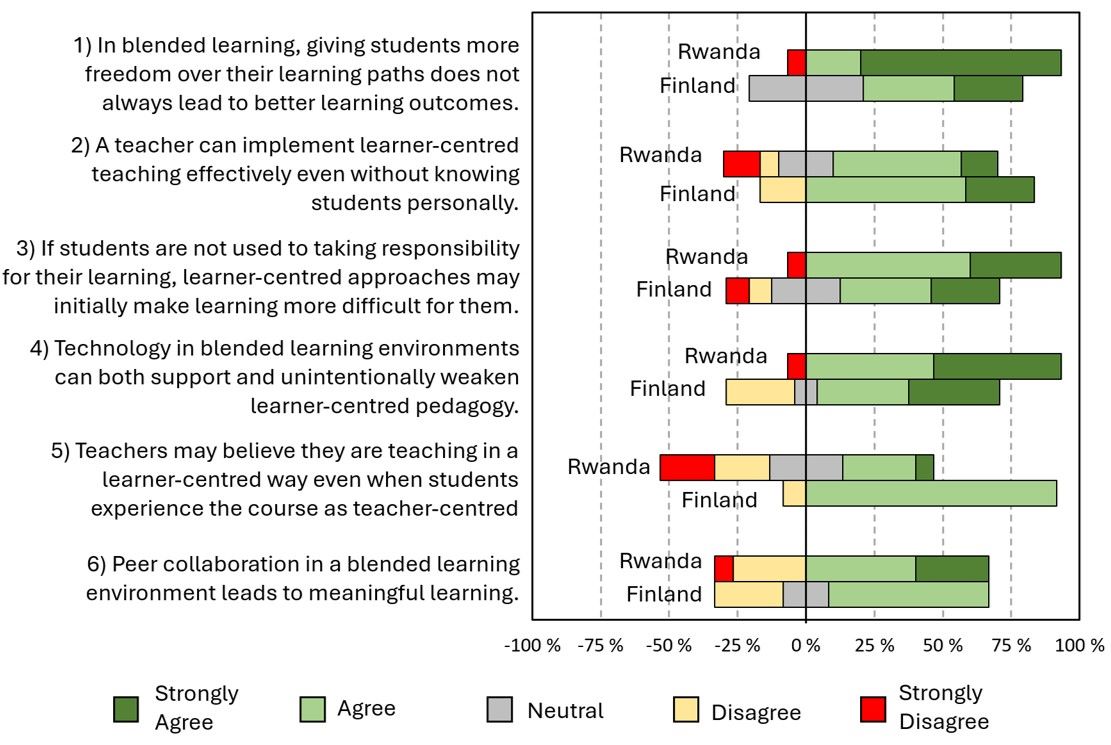
Figure 2 Distribution of Finnish and Rwandan participants’ responses to six Likert-scale statements related to learner-centred pedagogy and blended learning
What can both contexts learn from each other?
One of the clearest shared findings was related to student responsibility for learning. In both groups, most participants agreed that learner-centred approaches may initially make learning more difficult if students are not accustomed to taking responsibility for their own learning. This suggests that learner-centred pedagogy was not understood simply as giving students more freedom, but rather as an approach that also requires guidance, adaptation, and the gradual development of learner autonomy.
Similarly, both groups strongly agreed that technology can both support and unintentionally weaken learner-centred pedagogy in blended learning environments. Technology was therefore not viewed as automatically beneficial, but as something whose pedagogical value depends on how it is used in practice. This observation also connects to workshop discussions related to artificial intelligence and digital learning environments.
The largest difference between the groups appeared in the statement concerning teachers’ perceptions of their own teaching. Finnish participants agreed more strongly that teachers may believe they are teaching in a learner-centred way even when students experience the course as teacher-centred. This may indicate a more reflective or self-critical orientation towards pedagogical practice and student experience among the Finnish participants.
Technology was not viewed as automatically beneficial, but as something whose pedagogical value depends on how it is used in practice.
Another interesting difference was related to teacher–student relationships. Finnish participants generally agreed that learner-centred teaching can be implemented effectively even without knowing students personally, whereas the Rwandan responses were more divided. This may reflect different educational traditions and different understandings of the importance of personal relationships in teaching and learning.
Peer collaboration was viewed positively in both groups, although the Rwandan participants expressed slightly stronger agreement. This observation is also consistent with the qualitative workshop responses, where collaborative and participatory learning activities such as group discussions and shared classroom interaction were frequently emphasised.
Overall, the survey results complement the qualitative findings well. In both contexts, learner-centred pedagogy was considered important and meaningful, but the Finnish responses placed somewhat greater emphasis on pedagogical reflection, structures and possible challenges, whereas the Rwandan responses highlighted participation, facilitation and collaborative learning. The analysis reveals complementary perspectives on learner-centred teaching. These perspectives help both contexts to reflect on their own practices and to learn from each other, particularly in designing meaningful and sustainable learning in rapidly changing educational environments.
Conclusions for teaching development
The comparison also offered important perspectives for the further development of teaching at TAMK. The Finnish responses emphasised structure, safety, assessment, and pedagogical support, while the Rwandan responses highlighted participation, facilitation, and active engagement. Together, these perspectives remind us that learner-centred pedagogy is not only about giving students more freedom, but also about building meaningful structures, interaction and shared responsibility for learning. International collaboration of this kind helps make implicit pedagogical assumptions visible and encourages critical reflection on one’s own teaching practices.
Learner-centred pedagogy is not only about giving students more freedom, but also about building meaningful structures, interaction and shared responsibility for learning.
More broadly, the findings suggest that learner-centred pedagogy should not be understood as a single universal model. Instead, it is shaped by educational culture, institutional traditions and local teaching practices. Comparing perspectives from different contexts can therefore enrich pedagogical thinking on both sides. Especially in rapidly changing higher education environments shaped by blended learning, artificial intelligence and increasing learner diversity, there is growing need for pedagogical approaches that combine active participation, reflection, collaboration and supportive learning structures.
References
Biggs, J. B. (2011). Teaching for quality learning at university: what the students does. Open University Press.
Bremner, N. (2021). What is learner-centered education? A quantitative study of English language teachers’ perspectives. Tesl-Ej, 25(2).
Dewey, J. (1986). Experience and education. In The educational forum (Vol. 50, No. 3, pp. 241-252). Taylor & Francis Group.
Vygotsky, L. S. (1978). Mind in society: The development of higher psychological processes (Vol. 86). Harvard university press.
Weimer, M. (2013). Learner-centered teaching: Five key changes to practice. John Wiley & Sons.
Authors
Sami Suhonen works as a Principal Lecturer and Research Scientist at Tampere University of Applied Sciences (TAMK), Finland. He is part of the Mathematics and Physics team and works extensively in teacher education, STEM pedagogy and educational development projects. His expertise includes learner-centred pedagogy, active learning methods, AI in education, learning analytics and technology-enhanced learning environments.
Email: sami.suhonen@tuni.fi
ORCID: 0000-0002-3279-3813
Elina Harju is a Senior Lecturer at Tampere University of Applied Sciences (TAMK). She works as a teacher educator in Finland’s professional teacher education and in international in-service training projects. Her interests include activating teaching methods, collaboration, and building learning communities.
Email: elina.harju@tuni.fi
Photo: Adobe Stock