
Exam computers
Computer desktop
Software
Use of attachments
Computer accessories
Solutions to problem situations
Exam computers
Exam computers are Windows 11 computers with a limited software selection and no free access to the internet.
Computer desktop
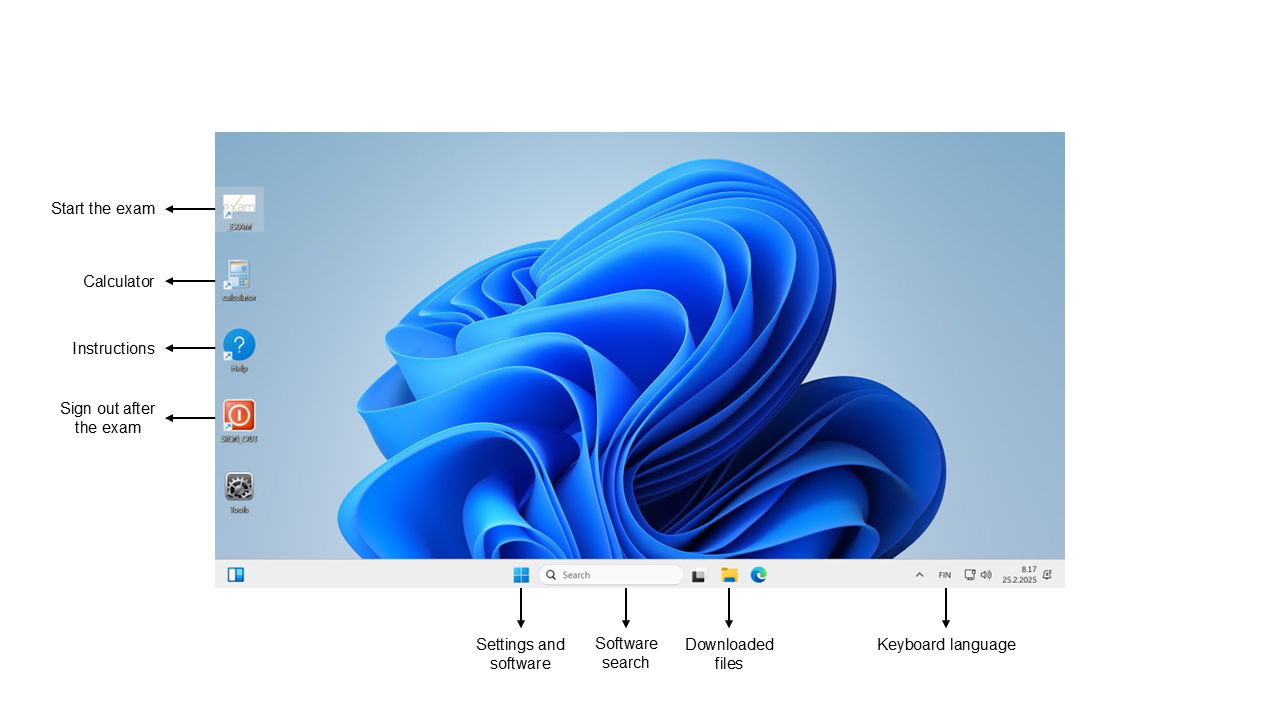
Description of the desktop
On the left side of the desktop, there are five icons with the following functionalities:
EXAM: Starts the exam.
Calculator: Opens the calculator.
Help: Opens a PDF file with solutions to common issues.
Sign Out: Logs out after the exam.
Tools: Opens a folder where you can switch the mouse button settings for left-handed use and install the RuSlav keyboard layout.
At the bottom of the screen, the taskbar contains several icons and functions:
Start: Allows you to change the exam computer settings and browse the software available during the exam.
Search: You can also use the search field to find software available during the exam.
File Explorer: If needed, you can access files saved on the exam computer.
FIN: Allows you to change the keyboard language if necessary.
Software
The computers in the exam rooms have access to over 30 different software applications. The use of the software cannot be restricted by exam.
List of software
- Blender
- Calculator (Note: Shortcut on the desktop.)
- ChemSketch 2020.1.2 Freeware
- CodeBlocks 20.03 + MinGW compiler and debugger
- Dia 0.97.2
- Fiji-ImageJ
- Haskell 2.4.4 and VSCode plugins
- IrfanView 4.51
- IBM SPSS Statistics 30
- JAGS 4.3.1
- JVSview
- MarvinSketch
- Matlab R2023a
- Microsoft Office 2019: Word, Excel, PowerPoint (Note: No spell chech.)
- Microsoft Visual Studio
- Mozilla Firefox ESR
- NetBeans IDE 18 + Java OpenJDK 17 (Temurin JDK with Hotspot)
- Node.js 22.4 LTS
- Notepad
- Notepad++
- NVDA screen reader (Note: Only in accessible exam rooms.)
- Paint (Windows 11 default app)
- Paint.NET
- PDF viewer (Windows 11 default app)
- PHP for Windows 5.6
- PyCharm Community Edition 2018.1
- Python 3.7.3 (Note: Includes default modules + NumPy, Matplotlib, Pandas.)
- R 3.6.2
- R-Studio 1.1.456
- RuSlav, Russian keyboard layout for Windows (Note: In Tools menu on computer desktop.)
- Typst compiler
- WxMaxima
- 7-Zip 16.00
In addition to the previous, the exam computers have been enabled to access the following online applications: Plussa, WETO (Exam Weto) and ÄlyOppi Moodle (STACK questions). These web applications have separate user restrictions. Please note that an exam visit is not possible if the exam is taken in Plussa, Weto or ÄlyOppi Moodle.
Software requirements for exams
The selection of software available on exam room computers is intentionally more limited than in computer classrooms used for teaching. Before requesting the installation of new software, consider whether an existing program could serve the same purpose. For example, diagrams can be created effectively using PowerPoint or Dia.
If no suitable alternative is available, you may send your software request by email to exam@tuni.fi. The TUNI EXAM team of the Tampere Universities community will review all software requests and assess possible solutions. Please take the following points into account before contacting us:
- Timeline: Include your desired timeline in the message. Contact us at least four months in advance.
- License terms: The software must be licensed under an open-source license, be completely free (freeware), or have a license that covers all users within the Tampere Universities community.
- User rights: If the license only allows a limited number of simultaneous users, the software is likely unsuitable for exam rooms, unless the allowed number is very high.
- Installation: Approved software will be installed on all exam room computers.
- Purpose of use: The software must be as widely used in teaching as possible and must not enable cheating.
Use of attachments
The examiner can add one attachment to the exam. In addition to this attachment, question-specific attachments are possible in the exam. The maximum size of one attachment is 50 MB. The exam must contain only attachments, which can be opened with the software available on the exam computer.
Tip: Small (less than 50 Mt) programs that can be used without installation can be attached to the exam.
Only one answer file can be attached to one exam answer. If your answer consists of multiple files, compress them to a ZIP folder. Right-click the answer file and select Send to. Then select Compressed (zipped) folder. Move all the files you want to the same zipped folder and finally attach it to the exam answer in the EXAM system.
Image, audio and video files
- Image file formats opened from EXAM directly to image viewer: jpg, jpeg, png, gif, bmp, tiff, tif, pbm
- Audio/video file formats opened from EXAM directly to media player: mp3, wma, wav, flac, m4a, mp4, mov, wmv, mpg, mpeg
Other image, audio and video files can be used, but they must be downloaded first to exam computer and then opened with an appropriate software.
Computer accessories
You can check the possible computer accessories from the EXAM room information pages. For example, headset, touch-screen display and Wacom drawing screen are available in certain EXAM rooms. If your exam requires the use of an accessory, please select it in the exam settings on the Basic information page (Special requirements for the exam computers and attachments). In this way, the exam booking of the students are automatically directed to the EXAM rooms and computers where the accessory in question is available during the exam.
Most EXAM computers have a touch-screen display, the accuracy of which is equivalent to drawing on a marker board. In addition, new Wacom drawing screens have been acquired, the accuracy of which is more similar to drawing and writing on paper.
Wacom drawing screen
Wacom Cintiq 16 drawing screen is well suited for exams where answering a question involves drawing, writing by hand, or counting by hand. The slope of the screen can be changed to fit your drawing position and the drawing quality corresponds to the accuracy of drawing on paper. The drawing option available on touch screens on typical EXAM computers is again more like drawing on a marker board.
Examiner instructions:
If your electronic exam requires the use of a drawing screen, you will need to select the software “Drawing screen (Wacom)” on the Basic information page of the exam. In this way, students’ exam bookings are automatically redirected only on computers with a Wacom drawing screen. The use of the drawing screen should also be mentioned in the instruction shown during the exam booking, so that students are aware of what accessories or software are required to take the exam.
You can create a test exam in the EXAM system to test the Wacom drawing screen. The test exam works like a real exam, so be sure to follow the electronic exam instructions.
Drawing screen instructions:
Use the drawing screen with Wacom stylus, which you can find in the holder located on the right side of the screen. The drawing screen responds only to its own stylus. There is a rubber on the narrower end of the stylus. When drawing or writing, you can let the palm rest on the drawing screen. The slope of the screen can be changed to fit your drawing position with the pedestal behind the screen.
The drawing screen is used with the software of your choice. For example, you can use Word, PowerPoint or Paint, if it is not otherwise instructed in the exam. While working on the exam answer, you should at times save the answer file to the computer. When you are ready, save the answer file to the computer for example as a PDF file, and attach it to the EXAM system. You will find more detailed instructions on how to use the drawing screen with Word next to the exam computer. Apply the instructions if necessary.
Instruction videos :
- Wacom Cintiq (YouTube)
- Wacom Cintiq Pro 16 Review (YouTube)
Solutions to problem situations
A PDF file has been created for the desktops of exam room computers. It contains solutions to the most common issues that a student may encounter during their exam. The student can open the file by clicking the Help icon located on the left side of the desktop. You can also preview the contents of the file in advance by opening the following PDF document: Solutions to Typical Problem Situations (PDF).